Topic
My Progress
Pug Score
0%
Study Points
+0
Overview
Watch
Read
Next Steps
Overview
Watch
Read
Next Steps
Watch
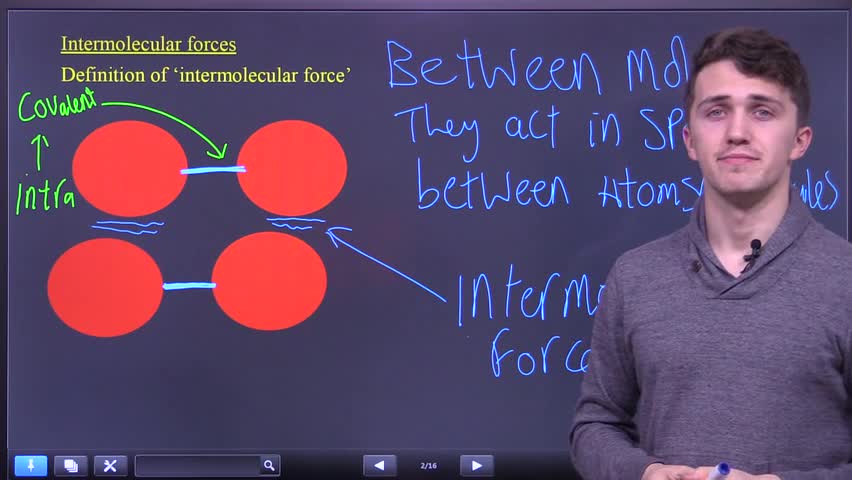
Intro to intermolecular forces and how they differ from intramolecular bonds
📝 My Notes
Auto-saves the current timestamp
Intro to intermolecular forces and how they differ from intramolecular bonds
4:40
About this lesson
Key Moments
No key moments available.
Video 1 of 13
Intro to intermolecular forces and how they differ from intramolecular bonds
5 min
• Selected
How dipoles form from electronegativity and electron repulsion
9 min
Understanding van der Waals dipole-dipole interactions
8 min
How London dispersion forces create instantaneous induced dipoles
8 min
Hydrogen bonding as the strongest intermolecular force
12 min
Cumulative intermolecular forces and unusual properties of water
6 min
How intermolecular forces determine solubility
7 min
Cumulative intermolecular forces and unusual properties of water
6 min
Identifying intermolecular forces in CH4 and H2O
7 min
Identifying intermolecular forces in Br2 and HBr
6 min
Ranking London dispersion forces in diatomic halogens
11 min
Ranking hydrogen halides by intermolecular force strength
8 min
Comparing intermolecular forces in ammonia, water, and methane
8 min